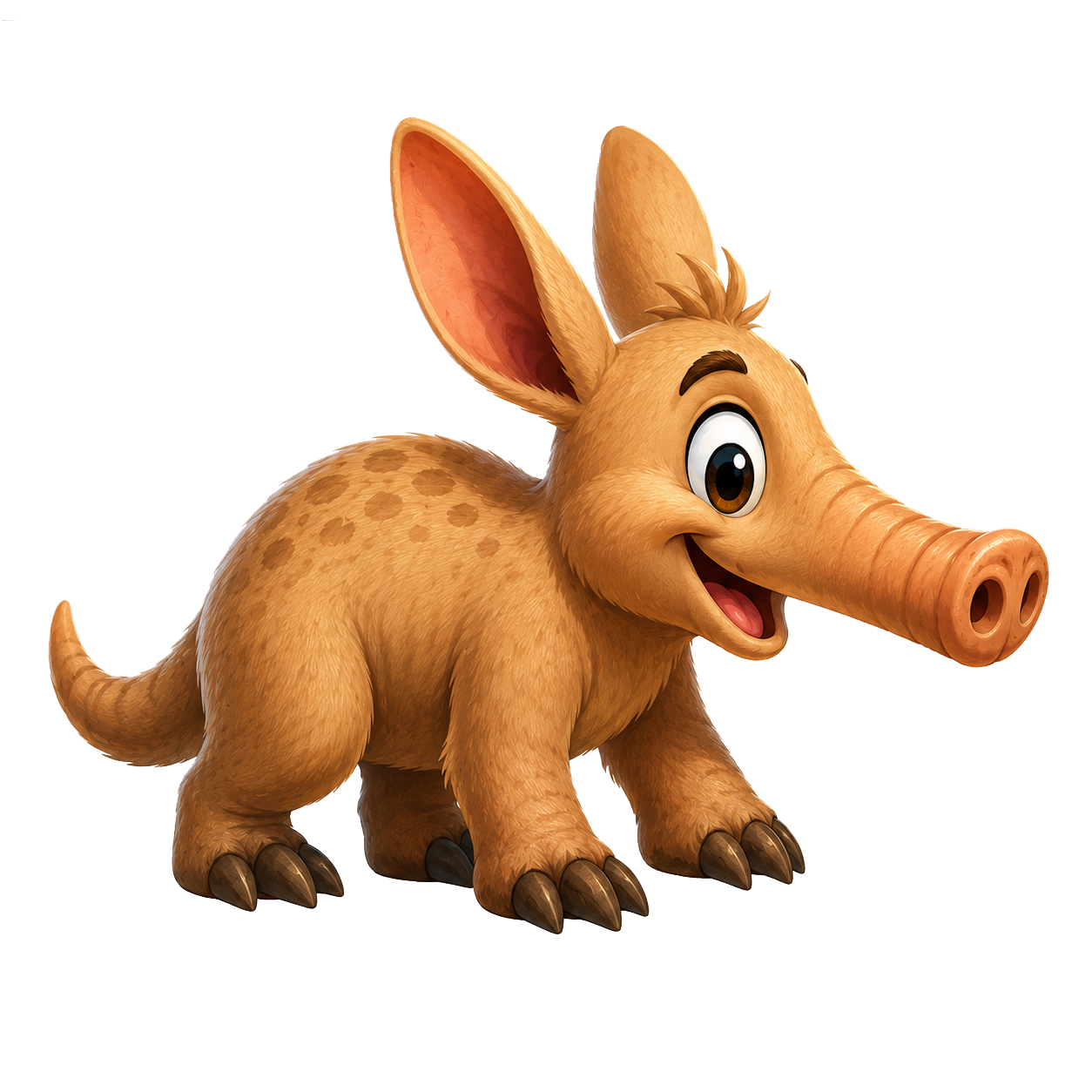
Precision snout
The snout is a sensor array
An aardvark's long snout is not just funny-looking. It is a specialist detection tool. Real aardvarks use smell to locate ants and termites, often pressing their snout close to the ground as they forage.
🎮 In Ahdvark, this inspires scent trails, ant detection and hidden swarm behaviour.
The tongue system
Stretch. Stick. Retract. Slurp.
Real aardvarks use a long, sticky tongue to collect ants and termites from tunnels and mounds. The game exaggerates this into a precision tongue mechanic: distance, angle, stickiness, retraction load and slurp efficiency.
🎮 This is why Ahdvark's tongue is not just an animation. It is the hero mechanic.
Digging hardware
Shovel claws. Serious engineering.
Aardvarks have powerful legs and strong claws for digging into hard ground, termite mounds and burrows. Their name even links to digging — the scientific name Orycteropus afer is commonly interpreted as 'African digging foot'.
🎮 This inspires burrows, ant hills, ground tunnels, nest entrances and terrain-based levels.
Built for night
Night shift specialist
Aardvarks are mainly nocturnal. They rest in burrows during the day and forage at night, using smell, hearing and digging ability rather than bright daylight vision.
🎮 Future Ahdvark levels can use night-mode mechanics: sound cues, scent trails, shadows and hidden ant routes.
Ears like scanners
Listening for danger
Those huge ears are not just cute. They help aardvarks monitor their surroundings while feeding, especially because feeding with your snout in the ground is risky.
🎮 This inspires warning cues, danger pulses and predator-aware challenge modes.
Plains adaptability
Adapted for open, demanding landscapes
Across parts of sub-Saharan Africa, aardvarks live in habitats such as savannas, grasslands, woodlands and bushland where digging, smell and efficient foraging are survival tools.
🎮 This is the world behind Ahdvark: open ground, hidden colonies, food trails and fast decisions.
Burrows as ecosystems
Aardvark burrows help more than aardvarks
Aardvark burrows can become shelter for other animals after they are abandoned. That means the aardvark is not only a hunter; it can also shape habitats for other species.